

HOW DO I UPDATE MY TORTOISE'S PHOTO DOCUMENTATION?
A Practical Example from Tortoise Keeping
LEVEL:
ESSENTIAL
ADVANCED
SCIENTIFIC
Accurate and traceable documentation is an important part of responsible reptile keeping. For tortoises, keeping the photo documentation up to date is particularly important: The animal must continue to be clearly assigned to the corresponding EU certificate based on its documented features. If this is no longer possible, the certificate may lose its validity.
But how do you practically update existing photo documentation?
In this practical example, I show how I update the photo documentation of my Greek tortoise – from preparation and taking the new photos to adding them to the existing documentation.
Note: This article documents one specific practical procedure. The exact requirements may vary depending on the species, conservation status, country, and responsible authority.
IN SHORT THIS IS HOW I UPDATE MY TORTOISE’S PHOTO DOCUMENTATION:
The photo documentation of my Greek tortoise is updated at the specified intervals so that the animal can continue to be clearly assigned to its EU certificate. To do this, current photos of the carapace and plastron are taken and added to the existing photo documentation. The required information, such as weight, keeper, location, date, and signature, is also recorded.
STARTING SITUATION
In this practical example, I show how I update the photo documentation of an approximately one-year-old Greek tortoise.
For Greek tortoises, specific intervals are provided for photo documentation (Table 1). Depending on the responsible authority, the recommended dates can also be found on the corresponding EU certificates or in official guidance documents.
For the tortoise shown here, a photo set was already taken in March during its first year of life. As a second photo set is scheduled for autumn during the first year, the existing photo documentation is now supplemented with the current photo set.
| photo set | age | timepoint for documentation | approximate age |
|---|---|---|---|
| 1 | Year 0 | Autumn (September - November) | 1-3 months |
| 2 | Year 1 | Spring (March - Mai) | approx. 8 months |
| 3 | Year 1 | Autumn (September - November) | approx. 14 months |
| 4 | Year 2 | Autumn (September - November) | approx. 26 months |
| 5 | Year 3 | Autumn (September - November) | approx. 38 months |
| ... | Year X | Annually until sexual maturity. From the 11th year onward, every 5 years. |
Table 1: Photo documentation intervals for Greek tortoises.
Source: Natur und Landschaft, Issue 1 (2007), p. 19 (Dr. C. Bender, Dr. K. Henle and P. M. Kornacker)
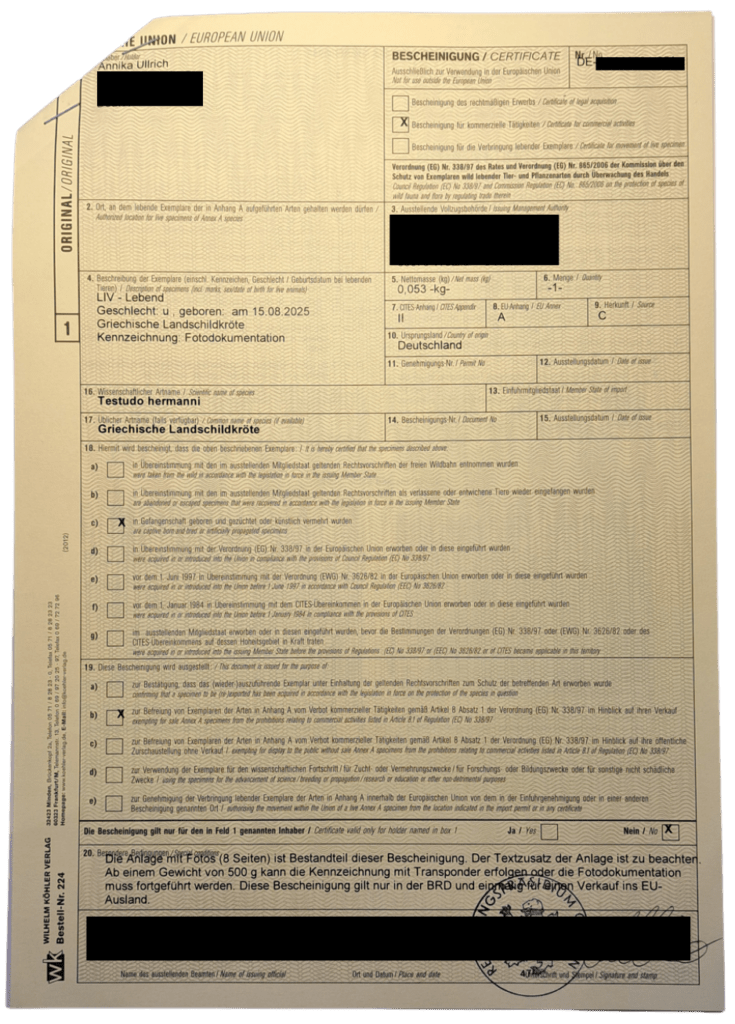
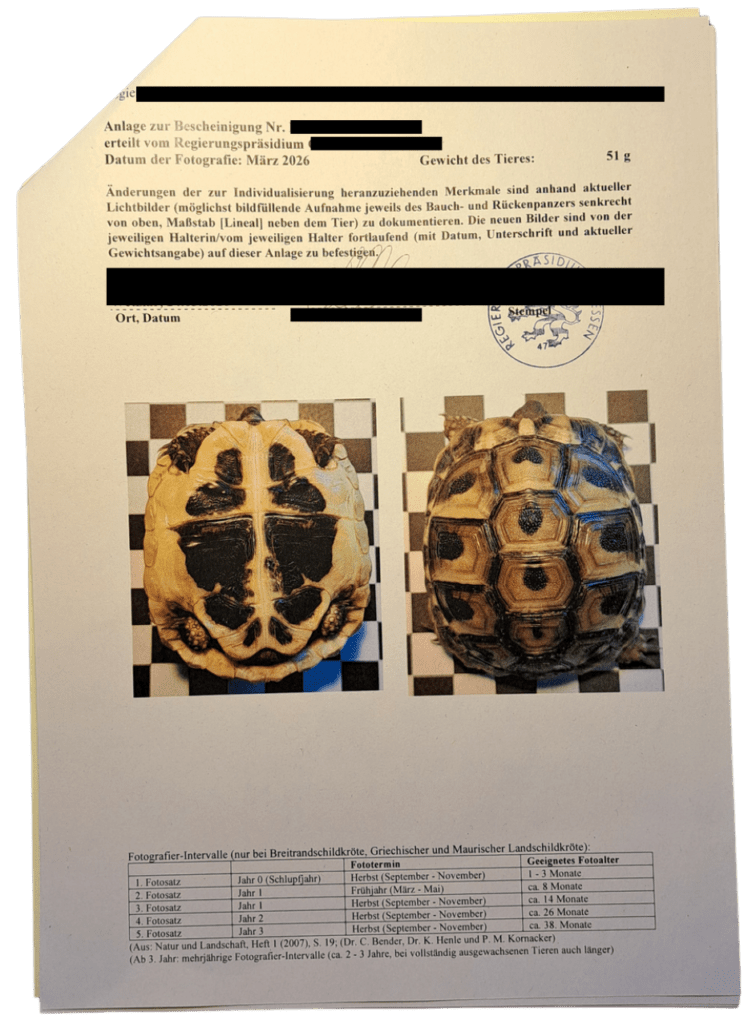
Figure 1: EU certificate of the tortoise, update required
CREATING THE PHOTO DOCUMENTATION
Preparation: Since there is often soil or other dirt on the shell, I carefully bathe the tortoise first so that the individual features of the carapace and plastron are clearly visible. Minor dirt is not a problem – what matters is that the individual features of the tortoise are clearly visible and identifiable in the photos.
The photos are taken in a well-lit area. I use checkerboard paper with a 1 × 1 cm grid as the background(download checkerboard paper). The grid also serves as a size reference and makes it easier to assess the animal’s size and proportions.
Photographing the carapace and plastron:For the photo documentation, I take one photo of the carapace and one of the plastron. The tortoise is positioned straight on the checkerboard paper and photographed directly from above.
For both photos, I make sure that the entire tortoise is shown clearly and in focus, well lit, and large enough in the frame. This ensures that the individual features of the shell remain clearly identifiable. In European tortoises, these include the cervical and last vertebral scutes on the carapace and the crossing lines on the plastron. Distracting shadows and reflections should be avoided as much as possible. One suitable photo of each the carapace and plastron is sufficient.
Adjusting the photos: I then crop the selected photos using the Crop function in Word so that the tortoise fills as much of the image as possible. I then adjust the image size to the specified dimensions of the corresponding section of the photo documentation and print the finished photos.
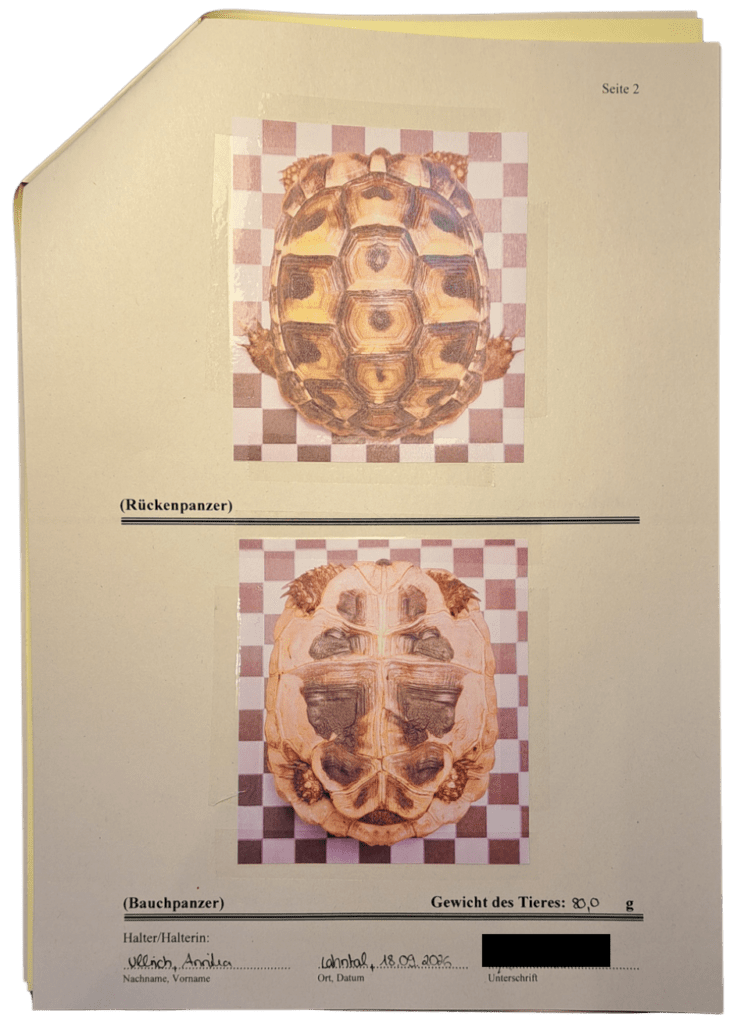
Figure 2: Updated photo documentation of the tortoise.
UPDATING THE PHOTO DOCUMENTATION
For the new photo set, I go to the next available page in the existing EU certificate. I attach the printed photos of the carapace and plastron to the designated areas using transparent tape.
I then add the required information. This includes the tortoise’s current weight, the keeper’s name, location and date, and the signature. Depending on the template used or the responsible authority, additional information, such as the tortoise’s length and width, may also be required.
The previous photo sets remain unchanged on the preceding pages of the documentation. The new photo set is added chronologically and thus represents the current status of the photo documentation.
A new submission of the documents to the authority is not required for this regular follow-up photo set. The subsequent photos are added and documented by the keeper themselves in the designated annexes of the EU certificate.
Note: If you keep multiple animals, take particular care to ensure that the new photo set is assigned to the correct animal and therefore to the correct EU certificate.
APPLYING THIS TO OTHER SPECIES
The update shown here is a specific example from keeping a Greek tortoise. The basic procedure can also be applied to other protected reptiles, provided that photo documentation is required for the respective species.
However, the required photos, the intervals at which the documentation must be updated, and the information that needs to be added may vary depending on the species and responsible authority. Therefore, the applicable requirements should be checked for each animal.
Note: For tortoises, there is generally also the option of using a transponder for legal identification from a body weight of 500 g. Below this weight, photo documentation must be used for tortoises that are subject to identification requirements.